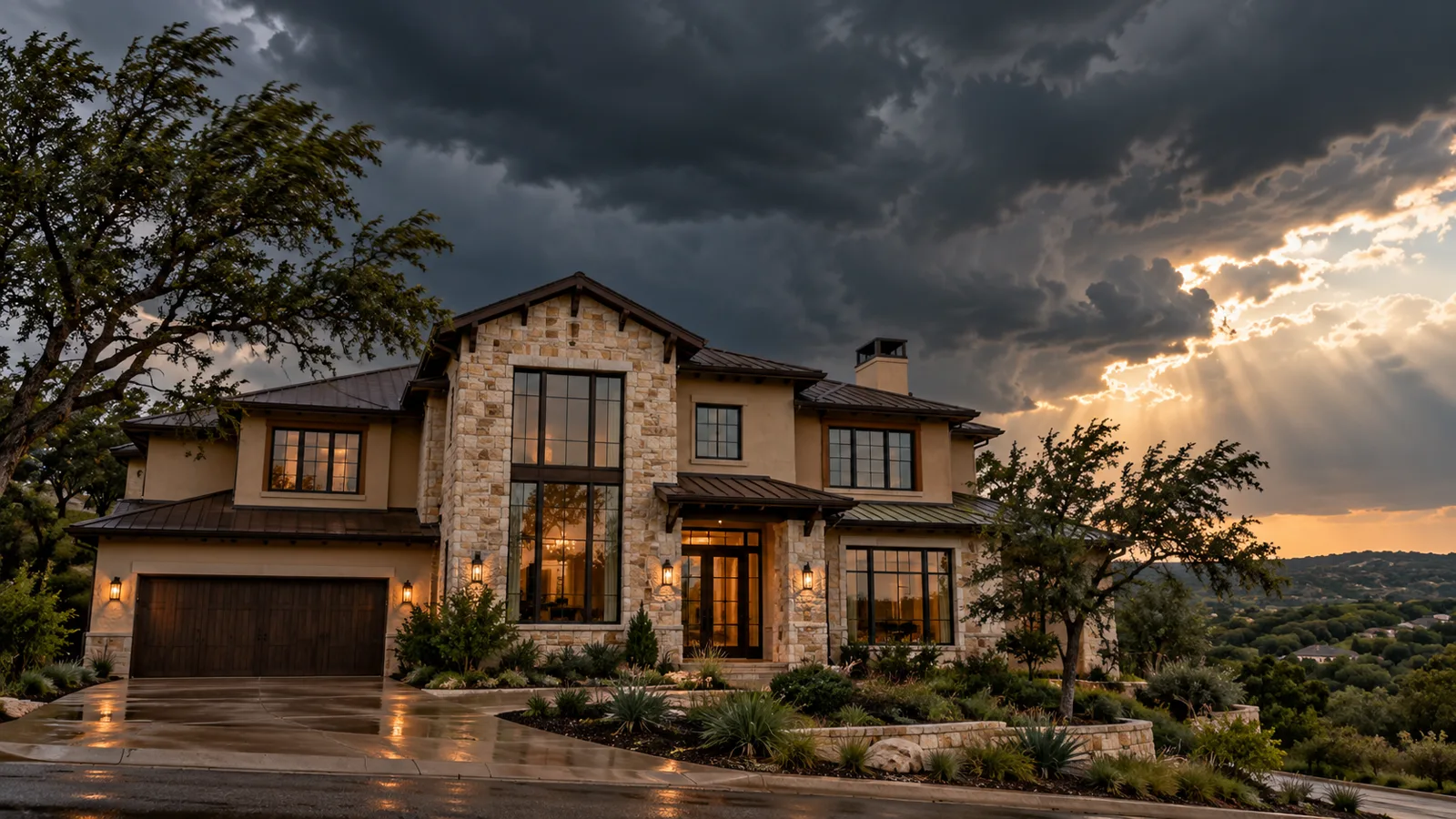
Crank operator
A geared crank pushes the sash open and pulls it shut against the weatherstrip. A folding handle tucks away so it clears blinds and shades.
Austin Quality Windows provides casement window replacement in Austin, TX across whole houses, and is Travis County's trusted specialist in side-hinged windows, specializing in crank-out casements, awning windows and casement and picture window combinations. We offer folding crank operators and multipoint locking hardware.
Our team provides bedroom openings sized against the emergency escape rule, delivering windows that seal shut and swing wide to the breeze for both residential and commercial projects. The same crew that installs your casements measures every opening first, draws the elevations you sign off on before ordering, and water-tests each sash before the interior trim is fitted.
From choosing which way each sash swings on a corner bedroom to a full set of casements matched across the house, our team handles every detail. Serving Austin, West Lake Hills, Barton Creek and Lost Creek, we set each hinge side so the open sash catches the wind your room actually gets.
Why Austin Quality Windows
No handoffs between a salesperson, a measurer and a subcontracted crew. The crew that measures your openings installs the windows.
A casement window seals tighter than a sliding window because its sash closes by pressing against the frame, compressing the weatherstrip all the way around, rather than gliding past it. That is why casements generally have lower air leakage rates than sliders, and why owners swapping old sliding units for casements often notice the house holding its temperature better.
The sash hangs on hinges at one side of the frame and swings out when the crank turns. On an outward-opening unit, the crank, a stay or a friction hinge holds the sash where you set it so a gust cannot slam it. When the crank closes the sash and the lock engages, the weatherstrip is squeezed between sash and frame from top to bottom.
In a Travis County summer, with highs of 90 degrees or more on about 123 days a year, that tight seal matters as much as the glass. A window that leaks air lets humid outdoor air in around the sash even when the glass itself is good.
Casements give more control over ventilation than any window that opens flush in its own frame. An outward-swinging sash can be angled to catch a passing breeze and steer it into the room, which is why casements have long suited hot climates.
The hinge side decides how well that works. A sash hinged on the side away from the wind scoops air in; hinged on the wrong side, it blocks the same breeze. At the measure we look at how each room sits on the lot, which walls face the afternoon sun, and where the open sash would meet a walkway, a shrub or a deck rail, and we mark the hinge side for every unit on the elevations.
Paired casements hinged on opposite sides open like a set of doors with no center post in the way once both are open. On a bedroom or a breakfast room that looks onto a view, that full, clear opening is often the reason owners choose casements in the first place.
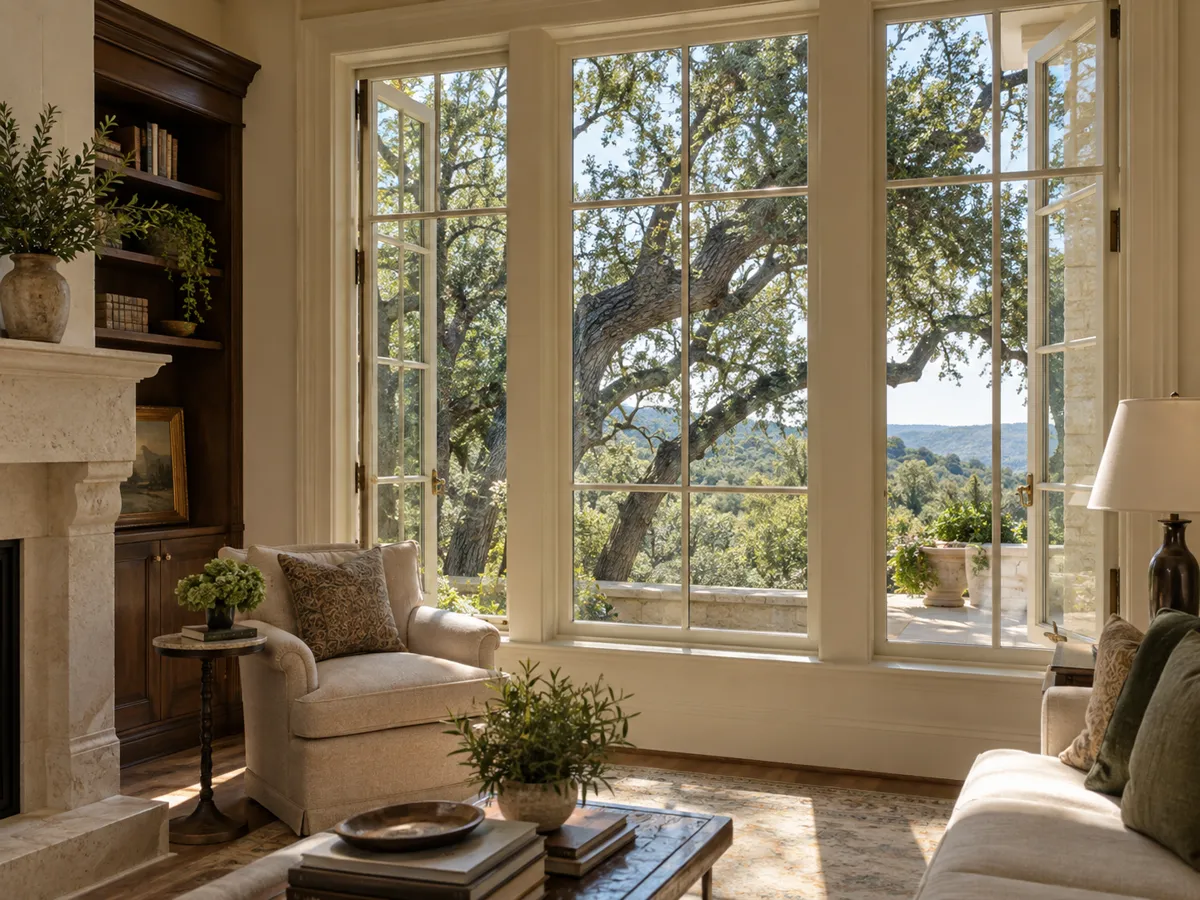
Every sleeping room needs an emergency escape and rescue opening under the International Residential Code. In the 2015 IRC that means a net clear opening of at least 5.7 square feet, at least 24 inches high and 20 inches wide, with the sill no more than 44 inches above the floor. Grade-floor openings may drop to 5 square feet.
A casement suits this rule well because the whole sash swings out of the opening, while a sliding sash only ever clears part of its frame. For a bedroom where an old slider barely met the clear-opening size, a casement of the same frame size usually gives more room to climb out.
The code also carries a replacement-window exception: a replacement may skip the size and sill-height rules when it is the manufacturer's largest standard size that fits the existing opening and is the same operating style, or a style that opens as wide or wider. We size every bedroom unit against the edition your city has adopted, which differs across our service area: West Lake Hills and Lakeway enforce the 2021 IRC and Volente the 2018 IRC. The current text is checked at quote time.
The hardware is what a casement owner touches every day, and it is usually the first thing to wear on an old unit. We specify each piece with the sash size and weight in mind.
A geared crank pushes the sash open and pulls it shut against the weatherstrip. A folding handle tucks away so it clears blinds and shades.
On many casements the handle that holds the sash closed is also the lock, drawing the sash tight against the frame when it is turned.
On a tall sash, locking points along the side pull it closed at more than one place, so the middle of the sash cannot bow away from its seal.
The hinge holds an outward sash steady against wind at any angle, so the open window does not swing or slam in a gust.
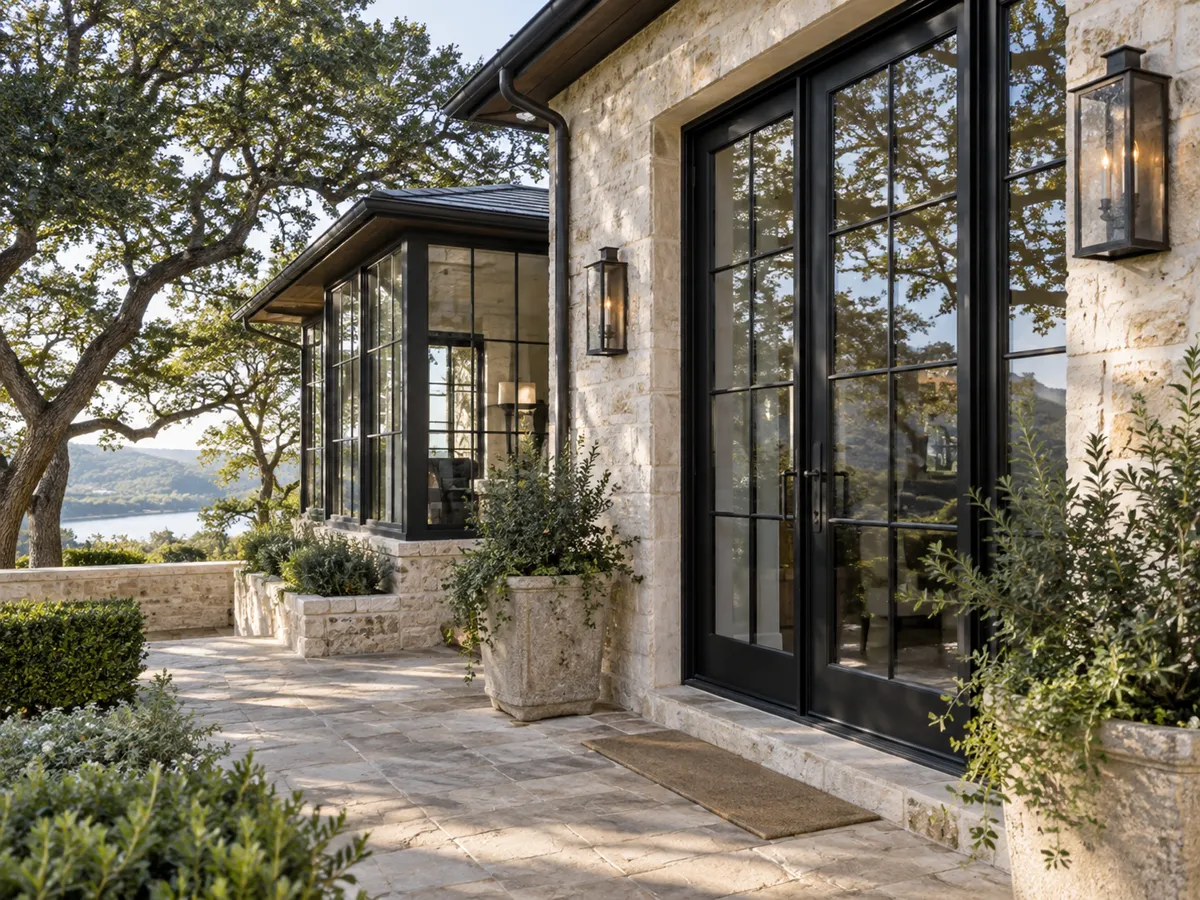
Casements are rarely ordered alone. The most common elevation pairs a large fixed picture window in the middle with an operable casement on each side, so the view stays unbroken and the room still gets air. The frames share one profile, so the sightlines line up from the fixed glass to the opening sashes.
An awning window is a casement turned on its side: hinged at the top, it swings outward from the bottom. Because the open sash forms a small roof, it can stay open in a light rain, and awnings can be stacked above or below fixed glass. A hopper is the reverse, hinged at the bottom. On a tall wall, an awning row under a picture window, with casements at the ends, gives ventilation at every height without breaking up the glass.
For glass on these combinations we work to Climate Zone 2, where the energy code applies a U-factor of 0.40 and an SHGC of 0.25 to replacement windows, read off each unit's NFRC label.
An old casement tells you it is finished in a few predictable ways. The sash drops on its hinges and drags on the sill, so the crank strains and the corner no longer meets the weatherstrip. The operator gears strip and spin without moving the sash. Fog appears between the panes once the insulated unit's seal has given out. On a wood casement, the bottom rail softens where rain has sat against it for years.
One of those on its own can be a repair. Several at once, across a house, is the point where new casements cost less over time than chasing each fault. We open and close every sash during the measure, check each hinge and lock, and note any glass that has fogged, so the written scope shows which openings are replaced and why. Where a frame is sound and only the hardware has worn, we say so.
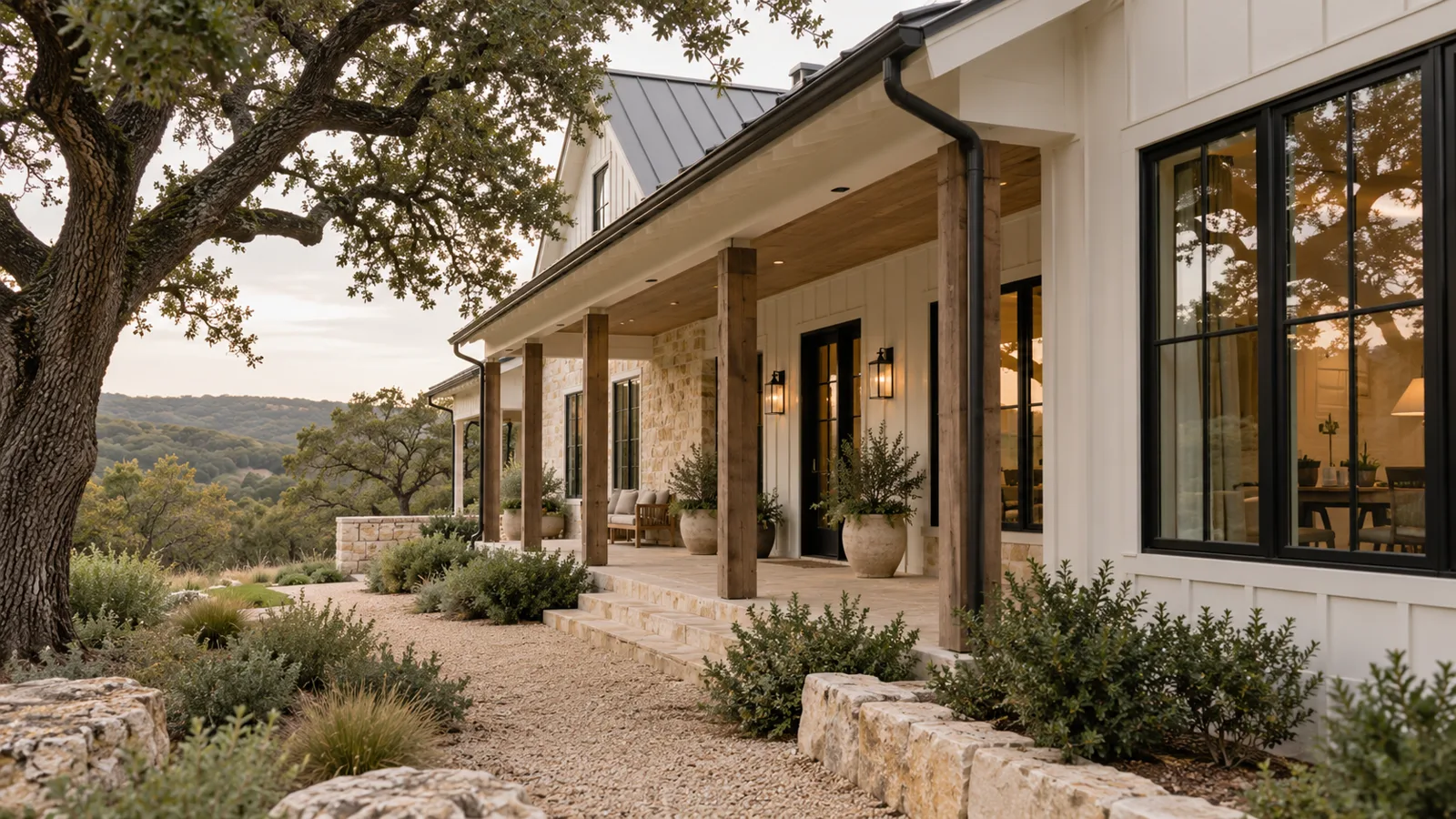
We do not post a casement price, because the opening, the hardware and the glass you choose all change it. These are the drivers we go through at the measure.
Each one is settled at the free in-home measure, where we review every opening and hand you a written price and scope.
The process
Four steps, and nothing is ordered until you have signed off on the drawings and the price.
We measure every opening, check the framing and the header, and talk through glass, frame material and how each window should operate.
You get drawings of every unit for your approval and for any HOA or historic review, with one written price.
Units are ordered to the approved sizes and glass package, and checked against the drawings when they arrive.
Old units out, openings flashed, new units set, sealed and water tested, then trim and cleanup.
Service area
Questions
They generally leak less air, because the sash presses against the frame when it closes. The glass performance is set separately by the insulated unit and low-E coating you choose, shown on the NFRC label.
Yes. We measure each opening, check the frame size and the clear opening for any bedroom, and draw the casement layout on the elevations before anything is ordered.
They are one of the best styles for it, because the whole sash swings clear. We size each bedroom unit against the IRC edition your city enforces.
It depends on where the breeze comes from and what sits outside the window. We mark the hinge side for each unit on the elevations so you approve it before ordering.
If the frames and glass are sound, worn operators and locks can be replaced as a hardware package. If the sashes sag or the glass is fogged, replacing the casements is usually the better spend.
It depends on the manufacturer, the frame material and the glass. We give you the date in writing with the quote.
Many do, especially when the style or color changes. We check the current rule for your address and prepare the elevations and specifications the committee asks for.
A measured, flashed and water-tested installation by our own crew, and a written warranty we go through with you at the quote.
Free in-home measure across Austin and the west side. We call you back to set a time.
Calls only, we do not receive text messages.