Argon fill
The common gas fill, chosen because it is affordable. Argon conducts roughly two thirds as much heat as air does, sealed in the same gap.
Austin Quality Windows delivers double-pane window replacement in Austin, TX for houses still living with single glass or failed seals, and is Travis County's trusted specialist in insulated glazing, specializing in argon-filled insulated glass units, low-E coatings and laminated glass for sound. We offer triple-pane units for the rooms that need them and warm-edge spacer options.
Our team provides glass specified wall by wall, delivering rooms that stay cooler in summer and quieter beside a busy street for both residential and commercial projects. We install each window ourselves, measuring every opening on site and reading you the NFRC label numbers on the drawings you approve before ordering.
From the desiccant sealed inside each spacer bar to every opening in the house reglazed and trimmed, our team handles every detail. Serving Austin, Volente, Lakeway and Rollingwood, we match the glass on each side of the house to the sun and the noise that side gets.
Why Austin Quality Windows
No handoffs between a salesperson, a measurer and a subcontracted crew. The crew that measures your openings installs the windows.
A double-pane window is two sheets of glass held apart by a spacer around the edge and sealed into one insulated glass unit. The gap between the panes, about a centimetre in a typical unit, is filled with dry air or an inert gas, and that still layer is what slows heat moving through the glass.
Each part has a job. The spacer sets the gap and runs around the whole perimeter. A primary sealant, usually polyisobutylene, keeps the gas in and moisture out, and a secondary sealant of polysulfide or silicone holds the edge together. Inside the spacer sits a desiccant, a drying agent that absorbs any moisture trapped when the unit was built, so the inner faces of the glass stay clear.
The panes themselves are typically between 3 and 10 millimetres thick. One of the inner faces usually carries a low-E coating, an invisible metallic layer that reflects infrared heat. Together those parts are the window's performance, and the frame around them is mostly there to hold the unit and seal it to the wall.
Mist or haze that you cannot wipe off from either side of the glass means the unit's edge seal has failed and the desiccant inside the spacer is saturated. Moisture now gets into the gap faster than it can be absorbed, and on a cool morning it condenses on the inner faces.
Large temperature swings put stress on the spacer adhesives, which is one reason a west-facing unit in a Travis County summer can fail sooner than its neighbors on a shaded wall. Once fog appears, it can generally only be cleared by replacing the insulated unit. Vent-drilling services can dry the visible moisture, but they cannot remove the mineral staining, and the gas fill escapes through the holes.
Whether we replace only the glass unit or the whole window depends on the frame. A sound frame with good hardware can take a new unit; a frame that has warped, rotted or lost its seal is replaced along with the glass. The measure tells you which, opening by opening.
We also look for the reason a unit failed. Water standing in a sash that does not drain, a sprinkler soaking the glass edge every evening, or a sealant attacked by the wrong glazing compound can shorten the life of a new unit as well, so the cause is fixed in the same visit as the glass. A replacement unit is ordered to the exact daylight size of the sash, with the same overall thickness so the glazing stops still fit.
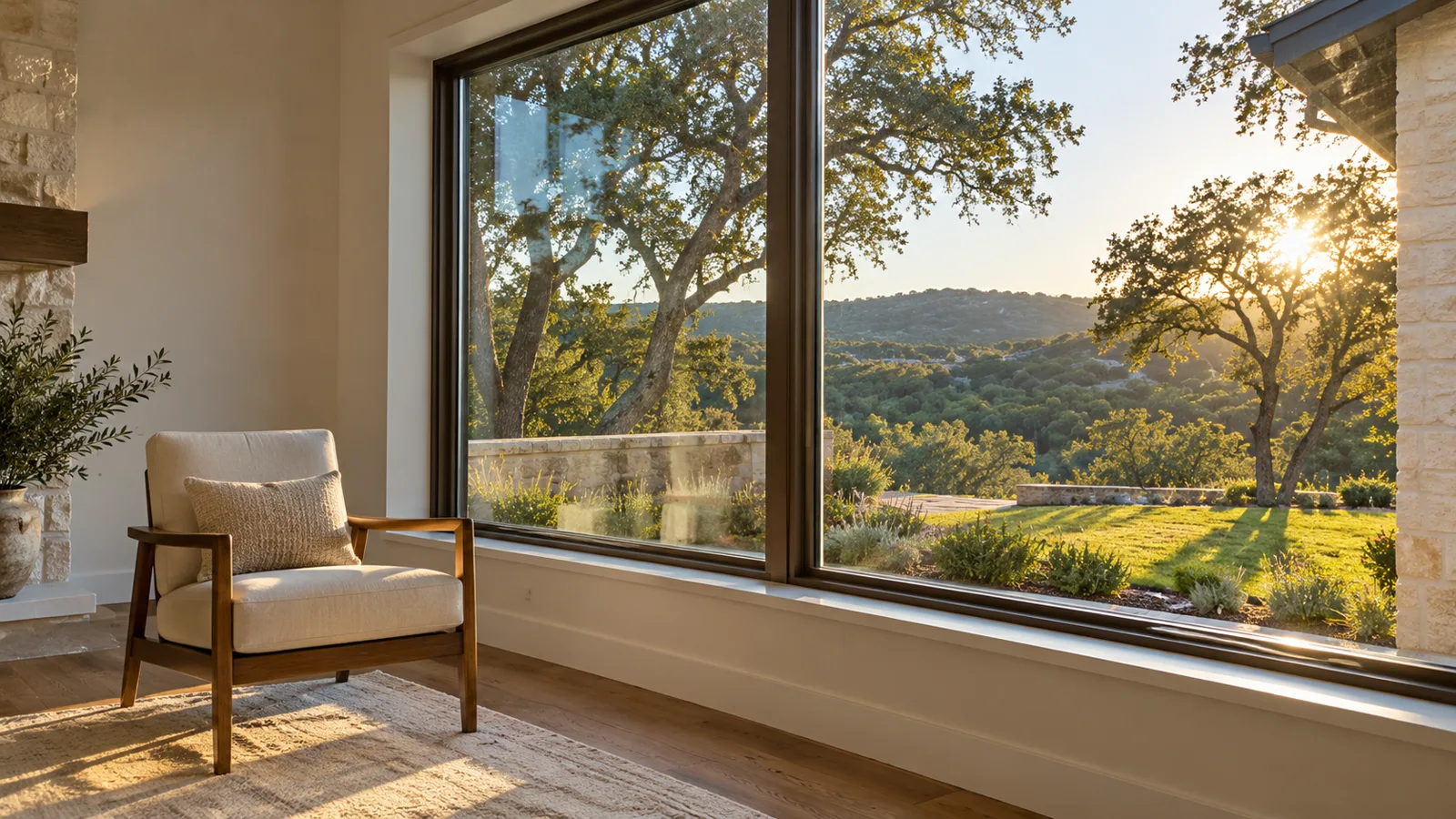
Going from single-pane glass to double-pane units almost always means new windows, not new glass in the old sashes. An insulated unit is much thicker than a single sheet, and while it can be fitted into a traditional double-hung frame, the wood usually needs significant modification to take it.
A single pane is the weakest part of any wall. In summer its inner face runs hot in the sun, and in winter it runs cold enough to collect condensation that drips onto the sill. A sealed double-pane unit with a low-E coating keeps the inner pane much closer to room temperature, which is what you feel standing beside it.
It also changes what the code expects. Travis County sits in Climate Zone 2, where the Texas energy code guide applies a U-factor limit of 0.40 and a solar heat gain coefficient limit of 0.25 to replacement windows under the 2015 IECC. Single-pane glass cannot meet those numbers. The NFRC label on every unit we supply shows its rated U-factor and SHGC.
The two choices that most change how a double-pane unit performs are what fills the gap and which coating sits on the glass.
The common gas fill, chosen because it is affordable. Argon conducts roughly two thirds as much heat as air does, sealed in the same gap.
Conducts about half as much heat as argon but costs far more, so it is kept for very thin units and some triple-pane glass.
A durable metallic coating bonded to the glass as it is made. Tougher and less costly, with lower performance than soft coat.
The better-performing coating, applied after the glass is made. It is delicate, so it is sealed inside the unit with an inert gas fill.
For most Austin houses, a well-specified double-pane unit with a low-E coating chosen for low solar heat gain is the right answer, and triple pane is a targeted upgrade rather than the default. A third pane adds insulation, but it also adds thickness and weight, which makes large operable sashes heavier to open and harder on their hinges and balances.
In a climate where the long summer sun is the main load, the coating that controls solar heat gain does more of the work than an extra pane. Triple pane earns its place on a bedroom facing a loud road, a media room, or a large fixed lite where weight does not matter and the owner wants the best figure on the label. We price both side by side at the measure so you can judge the difference on your own walls.
Double-pane glass usually cuts outside noise compared with a single pane, and a unit built for sound cuts it further. Three changes in the glass do most of that work, and each can be specified only on the walls that face the noise.
Pairing those with a frame that seals well, a casement or a fixed unit rather than an older slider, keeps the sound from simply finding its way around the glass. We mark which openings get the acoustic package on the elevations, so you pay for it only where it changes the room.
We quote no double-pane price before the measure, because the glass you choose and the openings you have set it. These are the factors.
All of it is settled at the free in-home measure, where we look at each opening and give you a written price and scope.
The process
Four steps, and nothing is ordered until you have signed off on the drawings and the price.
We measure every opening, check the framing and the header, and talk through glass, frame material and how each window should operate.
You get drawings of every unit for your approval and for any HOA or historic review, with one written price.
Units are ordered to the approved sizes and glass package, and checked against the drawings when they arrive.
Old units out, openings flashed, new units set, sealed and water tested, then trim and cleanup.
Service area
Questions
Yes, when the frame is sound. We order a new insulated unit to the measured size and set it in the existing sash. If the frame has warped or rotted, we replace the whole window.
Rarely without major changes, because an insulated unit is much thicker than single glass. In most houses the better result is new double-pane windows.
Argon is the standard fill because it insulates better than air at little added cost. Krypton insulates better again but is usually kept for thin units and triple pane.
Usually not across the whole house. A double-pane unit with the right low-E coating handles the sun; triple pane is worth it on noisy or exposed walls.
They usually reduce outside noise, and a sound-rated unit with laminated glass and unequal pane thicknesses reduces it further on the walls that face traffic.
It depends on the manufacturer and the glass. Insulated units are built to the measured size, and we give you the date in writing with the quote.
The City of Austin Historic Design Standards support retrofitting insulated low-E glass where appropriate, with no noticeable tint or reflectivity. We check the rule for your address and prepare what the reviewer needs.
Yes, every installation carries a written warranty, which we review with you along with the quote.
Free in-home measure across Austin and the west side. We call you back to set a time.
Calls only, we do not receive text messages.